The Old Fashioned
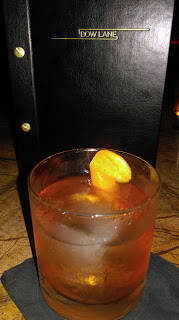
An Old-Fashioned from Bow Lane,
Dublin
"The Old-Fashioned Whisky Cocktail",to quote Simon Difford, was its original name. Its history can be seen as a bit like a game of Cluedo (Clue to my American readers): it's a case of who, where, and how.
History
The Old-Fashioned is the definition of a cocktail that was first published in ‘The Balance & Columbian Repository’, a publication from Hudson, New York in 1806. It was defined as a drink containing a mix of spirit, bitters, sugar and water. The Old-Fashioned went by a different name when it was first put down on paper in The Bartender's Guide by Professor Jerry Thomas in 1862, in which it was referred to as a Whisky Cocktail. In Thomas’ book it is also made in a different way, with its ingredients shaken up and strained into a chilled Martini glass. At that time the drink was imbibed as an "eye opener", something like your morning coffee, something to shake off the hangover from the night before. By the 1840s the Old-Fashioned had grown in popularity.
About 20 - 30 years later, some bartenders started putting their own twists on the Whisky Cocktail, calling it the Improved Whisky Cocktail. This new variation was made with the addition of Absinthe, Maraschino liqueur, Curacao, Chartreuse or other liqueurs. This change in what was being served infuriated the older drinkers in the bars they preferred the original way of making the drink. This change prompted them to begin ordering the Old-Fashioned Whiskey Cocktail. It is from this that the name for the Old-Fashioned most likely stemmed.
Throughout the history of the Old-Fashioned, people and bars have claimed to invent the Old-Fashioned, most notably The Pendennis Club, a private members club in Louisville, Kentucky, founded in 1881. The Pendennis Club stated in a release in 2009 that the drink was made "different to the run of the mill Old-Fashioned being requested and consumed at the time." The recipe The Pendennis Club made included exclusively Kentucky Bourbon and three fruits (lemon, orange and cherry), muddled together with sugar syrup and bitters before adding ice . The Pendennis Old-Fashioned was said to be created for a Kentucky Colonel James E. Pepper who was also a Bourbon distiller. However in a 1914 book called Drinks by Jaqcues Straub (a former manager at The Pendennis Club) the Old-Fashioned is listed but there is no mention of it being created at the club itself. The Pendennis may have been the first to muddle fruit into their Old-Fashioned but, due to the fact that it is a private club with no written records, the muddled version of the Old-Fashioned didn't appear in cocktail books until after Prohibition.
Prohibition was unkind to many drinks, most of all the Old-Fashioned. The introduction of the Volstead Act saw many of the skilled bartenders move overseas to Europe or retire altogether. The speakeasies that operated during Prohibition were not concerned with the quality of what they served, so Canadian whisky replaced bourbon as the spirit in the Old-Fashioned and fruit was used in the making of it allegedly to mask the poorer quality of the liquor being used. The Old-Fashioned survived Prohibition and in 1935, two years after Repeal, The Brooklyn Eagle reported on the popularity of various cocktails in large hotels throughout the country and reported that “The Old-Fashioned cocktail [was] leading."
The introduction of Prohibition also brought about a change in the drinking culture in the America. The bars were no longer just a man's drinking spot;men and women now drank side by side (something not done before Prohibition). Women not only openly drank but, as discerning drinkers, had no problem in quizzing the bartenders on the ingredients of cocktails. In Robert Simonson's The Old-Fashioned he quotes a manager from the Lotus Club as saying "Women patrons at (my) place order Old-Fashioneds more often than any other cocktail." Women's love of the Old-Fashioned during that time is probably best captured in a song by Ruby Keeler in 1935 called "A Good Old-Fashioned Cocktail (with a Good Old-Fashioned Gal)."
The 1950s and 1960s saw a decline in the popularity of the Old-Fashioned, and the rise of vodka and vodka cocktails saw it fade into the background. It wasn't until 1987, when a artender was tossed a copy of Jerry Thomas' Bartender's Manual and asked to create a menu of classic cocktails, was it to appear again. That bartender was Dale Degroff of The Rainbow Rooms. Dale give rise to classic cocktails that had almost disappeared, like the Bronx, Sazerac, Whiskey Sours and the Old-Fashioned, and so they all began to make a comeback. Dale's recipe for the Old-Fashioned was one he grew up with, a muddled fruit version that was "punchy and wonderful tasting" as he calls it.
The Old-Fashioned was back again, and its revival brought back the age-old argument of how it should be made: with or without fruit, muddled or not? It is a discussion that is nearly as old as the cocktail itself and will probably continue for years to come. Its revival has also brought with it new twists on the classic, from PDT's Benton's Old-Fashioned (using bacon-infused Bourbon) and Death & Co's Oaxaca Old Fashioned (using aged Tequila) to one created closer to my home at Upstairs in Dublin called Celtic Fusion (with a mixture of Irish and Scotch Whiskey).
What ever way you enjoy your Old-Fashioned is up to your own taste, so enjoy nearly 200 years of history with every sip. Either way, it is back, and hopefully it will never fade again.
Recipes
The Benton's Old-Fashioned
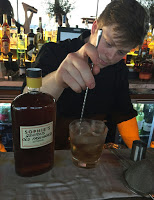 | |
|
50ml Bacon fat-infused Bourbon
15ml Grade B maple syrup
2 dashes Angostura bitters
Garnished with an orange twist
Method
Combine all the ingredients except the orange twist in an Old-Fashioned glass. Stir with ice. Twist a large piece of orange over the glass and drop it in.
Bacon fat-infused Bourbon
50ml Bacon fat
1(750ml) bottle of Bourbon
Warm the bacon fat in a small saucepan on a low heat, stirring for about 5 minutes till it is melted. pour fat and bourbon into a freezer safe container and stir. Cover the container and let it sit at room temperature for 4 hours. Next place the container in the freezer for a further 2 hours. Remove the solid fat layer on the top of the bourbon and discard. filter the bourbon through a cheesecloth or a coffee filter into a bottle. Store in the fridge and use within 2 months.
Oaxaca Old-Fashioned

Oaxaca Old-Fashioned made by The Ivy, Dublin
50ml Reposado Tequila
2 dashes of Angostura bitters
15ml Agave syrup
Garnished with an orange twist
|
| Oaxaca Old-Fashioned made by The Ivy, Dublin |
Method.
Combine all the ingredients except the orange twist in an Old-Fashioned glass. Stir with ice until chilled. Twist a large piece of orange over the glass and drop it in.
 |
| Celtic Fusion made by Upstairs@Kinara Kitchen, Dublin |


